1 Peter 2:9-17
But you are not like that, for you are a chosen people. You are royal priests, a holy nation, God’s very own possession. As a result, you can show others the goodness of God, for he called you out of the darkness into his wonderful light. “Once you had no identity as a people; now you are God’s people. Once you received no mercy; now you have received God’s mercy.” Dear friends, I warn you as “temporary residents and foreigners” to keep away from worldly desires that wage war against your very souls. Be careful to live properly among your unbelieving neighbors. Then even if they accuse you of doing wrong, they will see your honorable behavior, and they will give honor to God when he judges the world. For the Lord’s sake, submit to all human authority—whether the king as head of state, or the officials he has appointed. For the king has sent them to punish those who do wrong and to honor those who do right. It is God’s will that your honorable lives should silence those ignorant people who make foolish accusations against you. For you are free, yet you are God’s slaves, so don’t use your freedom as an excuse to do evil. Respect everyone, and love the family of believers. Fear God, and respect the king.
Every election season, the air thickens with a familiar kind of tension. Polls flood the news. Predictions multiply. Anxiety builds. People speak of hope for a better life, a fairer system, a government that finally gets it right. And if we are honest, many of us feel that pull too, that quiet longing for things to be easier, more stable, more just.
But here is where the Bible offers something unexpected, and perhaps uncomfortable: God never promises his people a comfortable life. In fact, Scripture consistently calls believers to something far more demanding and far more glorious than political optimism. It calls us to remember who we are, to respect human authority, and above all, to remember that the Lord reigns.
Remember Who You Are
The apostle Peter writes to a community of believers scattered across a hostile world. His words in 1 Peter 2, beginning at verse 9, are worth sitting with slowly. He describes Christians as a chosen people, royal priests, a holy nation, God's very own possession. He reminds them that they were once in darkness and have been brought into light. Once without mercy, now recipients of it in full.
And then he calls them something striking: foreigners. Temporary residents.
This is not a statement about immigration status. It is a statement about identity. Before coming to faith, these people blended into their surrounding culture. They fit in. But now that they belong to God, this world is no longer truly home. Their citizenship, as Paul puts it in Philippians 3:20, is in heaven.
This matters enormously when political seasons arrive. Before we voice an opinion about a party, a policy, or a politician, we need to pause and ask: who am I? The answer shapes everything. We are people who carry the goodness, the light, and the mercy of God into every space we occupy. That identity does not shift with election results. It does not depend on who wins or loses. It is anchored in something far more permanent than any government.
The philosopher Plato, when told that someone was making slanderous charges against him, reportedly said: "I am going to live in such a way that no one will ever believe what he says." That is precisely the kind of conduct Peter is urging. Let your life be the argument. Let your behaviour be the witness. As one writer put it, the strongest missionary force in the world is a Christ-filled, grace-centered, attractive life.
Respect Human Authority
Peter does not stop at identity. He moves directly into something that many Christians find difficult to swallow. In verses 13 and 14, he instructs believers to submit to all human authority, whether king or appointed official. Paul echoes this in Romans 13:1-2, reminding us that there is no authority except that which God has established.
This is where many of us bristle. Surely not every government deserves respect? Surely not when policies are corrupt, or morally bankrupt, or simply wrong?
The story of Pastor Andrew Brunson brings this tension into sharp relief. For over two decades, Brunson served faithfully in Turkey, planting a church, paying his taxes, honouring local laws, and loving his community. He was no political agitator. And yet in 2016, following a failed coup attempt, he was arrested on false charges of espionage and terrorism. His real crime was preaching the gospel. He faced a potential 35-year prison sentence.
Through two years in a high-security prison, Brunson continued to honour the authorities at every point, while refusing to renounce his faith. When he was eventually released and met with government officials back in the United States, his posture remained one of humility and prayer rather than political grandstanding. God asked him two questions during that ordeal: will you love me when you cannot see my love? Will you be faithful to me when you cannot see my faithfulness? He answered yes, and his life showed it.
This is not passive silence in the face of injustice. Scripture is clear in Acts 4:19 that when government commands what God forbids, or forbids what God commands, we must obey God rather than human beings. The framework is simple: if obeying a human authority requires disobeying God, there is no question about where our allegiance lies. But short of that line, we are called to respect, to honour, and to submit, not because governments always deserve it, but because God is sovereign over them.
Remember That the Lord Reigns
This is the ground beneath everything else. It is the truth that makes the other two points possible.
Daniel 2:20-21 declares that wisdom and power belong to God, that he changes times and seasons, deposes kings, and raises up others. Proverbs 21:1 says the king's heart is like a stream of water in the hand of God, directed wherever he wills. Theologian Jerry Bridges observed that God can and does work in the hearts and minds of rulers and officials to accomplish his sovereign purpose, their hearts as much under his control as the physical laws of nature.
This is not a call to passivity. Vote. Pray. Engage. Speak where you are invited to speak on matters of justice and ethics. But hold all of it with open hands, trusting that the outcome rests in hands far more capable than ours.
There is no denying that life is genuinely hard for many people right now. The cost of living, unemployment, crime, failing health systems, these are real and weighty concerns. God knows. He is not distant from any of it. And he has not surrendered control of history to chance or to any political party.
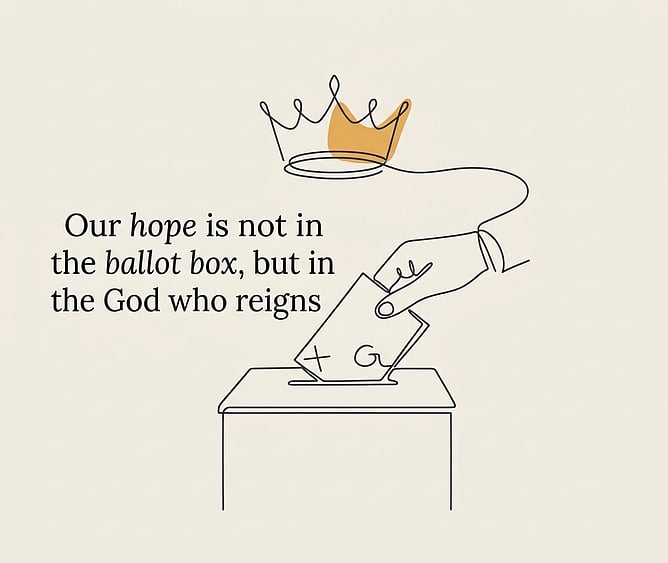
Our hope is not in any past, present, or future government. It is not in the next election cycle or the next economic forecast. Our hope is anchored in a coming King who has never lost an election and will never lose his throne.
So when the results come in, whatever they are, the mission remains unchanged. The call remains the same. Remember who you are. Respect the authority God has placed. And above all else, remember that the Lord reigns.
That is not a consolation. It is the foundation.